Coon cats first.
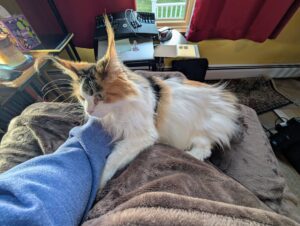
The morning cuddle:
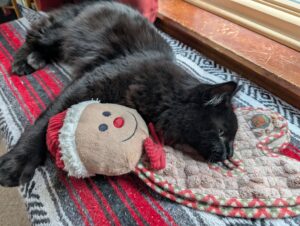
Rookie inna winda:
##
Yes, this is much better...
"Homemade lightning is never as good as the real sort."
"Things are either real or they're not. I know this. I have medicine."
And not to forget: A chocolate you don't want to eat does not count as chocolate.
SOMEONE MOSTLY MORTAL. SOMEONE LIKE YOU.
Sigh. Reading protocols.
The book I gave up on is set in The Real World; it's based on a Real Incident that took place in the Real City (not Small Town; and I say this as someone who hails from a City) of Lewiston, Maine; addressing the culture clashes born of the influx of Somalis into that same Lewiston, Maine.
You would think that, the author's interest obviously having been snagged by this incident, that her work would reflect that interest. That she would, dammit, love her characters.
Only she doesn't. Or maybe that's -- I hope she doesn't. Because these are not lovable people. It's not that they're flawed, or even that they're strange. We're all flawed. And strange. It's not that there's a tragedy in their shared past. Perhaps it's that they're caught in a shared net of meanness and dislike that none of them even tries to cut through.
Perhaps it's because the author doesn't love her characters, and so she keeps them at arm's length, reduced to telling us that Bob is lovable, without showing us that Bob is doing lovable things.
Mind you, the author is a Pulitzer Prize winner, so by definition she knows what she's doing, and I'm talking through my hat. Best to keep that in mind while I rant on. Since I'm apparently going to rant on...
Of all of the characters I met before I bailed, it is Bob -- supposedly lovable, insightful, and empathic -- who ought to have changed the course of this terrible family of hateful individuals. But Bob is sunk is self-pity. He's in his fifties, his wife has left him (of course), he's been unable to father children (I have no idea if the author is an academic, but ghod that is such an academic fiction thing), and drinking cheap wine out of coffee cups, which, OK, as a sign of moral decay, not having a wine glass is kind of -- cute.
And the Heroic Big Brother, who is falling apart at the seams -- a grown man, a trial lawyer, does not scream at this brother over the phone calling him a useless retard over and over again unless something is very Very wrong there, and I still fear for his wife, though I don't like her, either.
And, yes, I'm aware that not all characters have to be likeable. They do, however, have to be relatable.
*deep breath*
Pratchett clearly loves his characters, flawed and strange and deeply, Deeply improbable as they all are. He doesn't tell you that Jeremy isn't a bad man. He doesn't tell you Jeremy's a good man. He does need medicine, but who among us has not needed medicine? And who among us at least doesn't know someone who has stopped taking their medicine, because everything is So. Much. Clearer. without it?
(And the flashback that explains the advent of the medicine -- Something like, "after the hammer is taken out of the fist, and the blood has been cleaned up." Bang. No need to say any more than that. We Get it.)
Igor -- gods, I love the Igors. So naive, so able. So wise. So very fitted for Mad Science, and in love with their lightnings.
And, yanno, if we want to talk about Family Dynamics, there's Susan and her grandfather. Both flawed. Both strange. At odds more than they're in agreement. And yet -- MEET ME, says the note, and Susan goes to find out what her grandfather might need from her. Because they're family. And they only have each other. If you don't count Death of Rats.
And of course Lu-Tze, the Sweeper, not holy, not a monk, designer of bonsai mountains, and unwilling teacher of a boy who is far too smart, and who remembers his lessons instead of learning them.
Deep breath.
Circling around again to reading protocols. In science fiction, and in fantasy, the reading protocol demands that the reader allow that the author is telling them the truth, no matter how improbable it seems. This is called "The Willing Suspension of Disbelief," and it's actually a requirement for anyone who reads fiction. Because the author is not telling you the truth, no matter how much she may herself believe what she's writing. That's why it's called "fiction."
So, I'm wondering if my apparently on-going problem with non-genre fiction set in the here-and-now is that the authors don't do any worldbuilding. Why bother? Look around you. I've also heard it said by literary writers that characterization is . . . I can't think of the word -- in essence, a cheat. A crutch. When -- at least in my not at all humble opinion -- characterization is the greatest strand in the braided art called storytelling.
Eeep.
I think I may be ranted out.
Who are your favorite characters in fiction -- and! Bonus Question: Why?
![[personal profile]](https://www.dreamwidth.org/img/silk/identity/user.png) rolanni
rolanni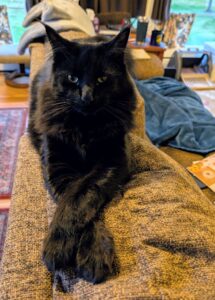

![[syndicated profile]](https://www.dreamwidth.org/img/silk/identity/feed.png)